12 Axes Test Left or right was never the whole answer.
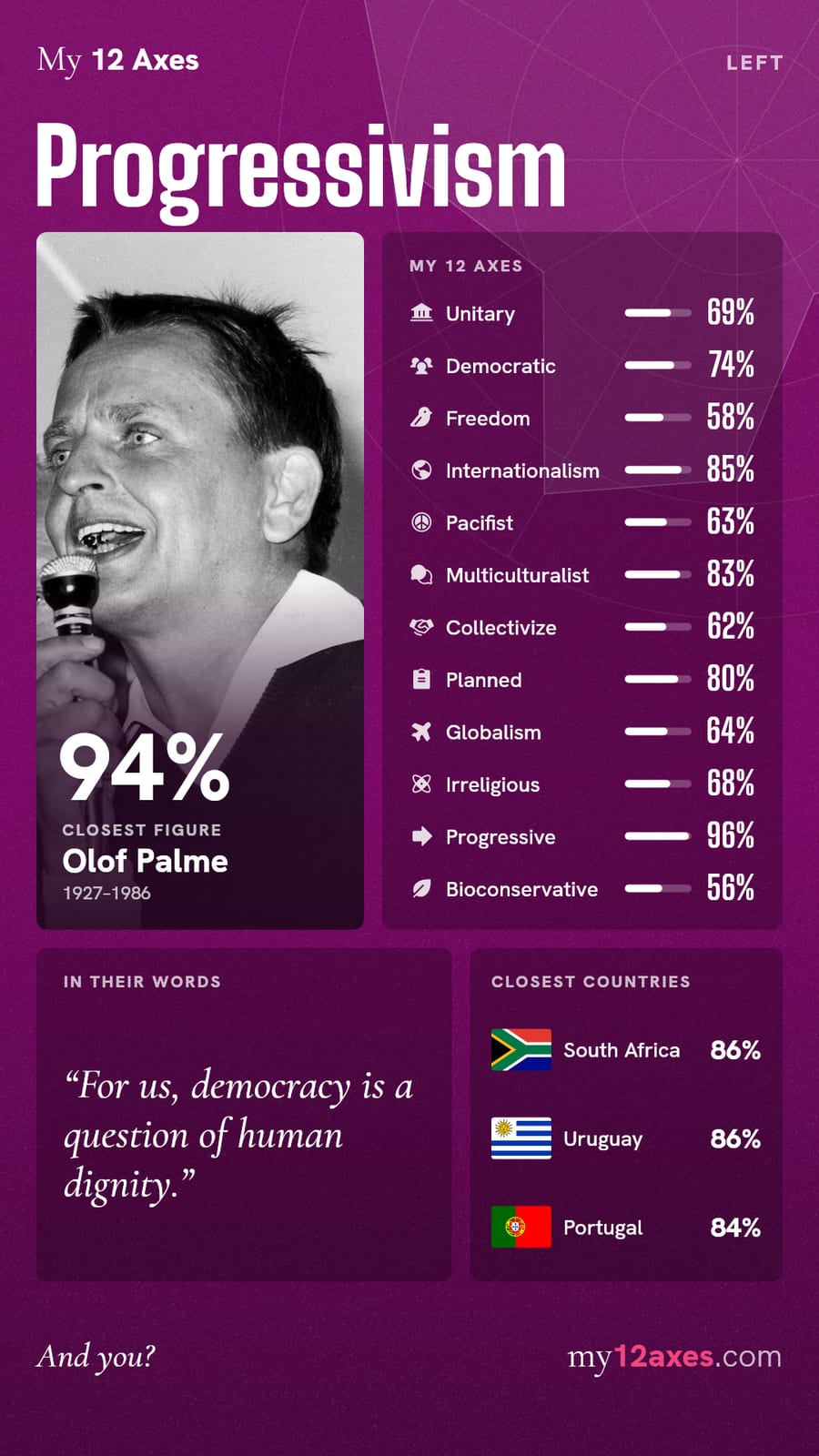
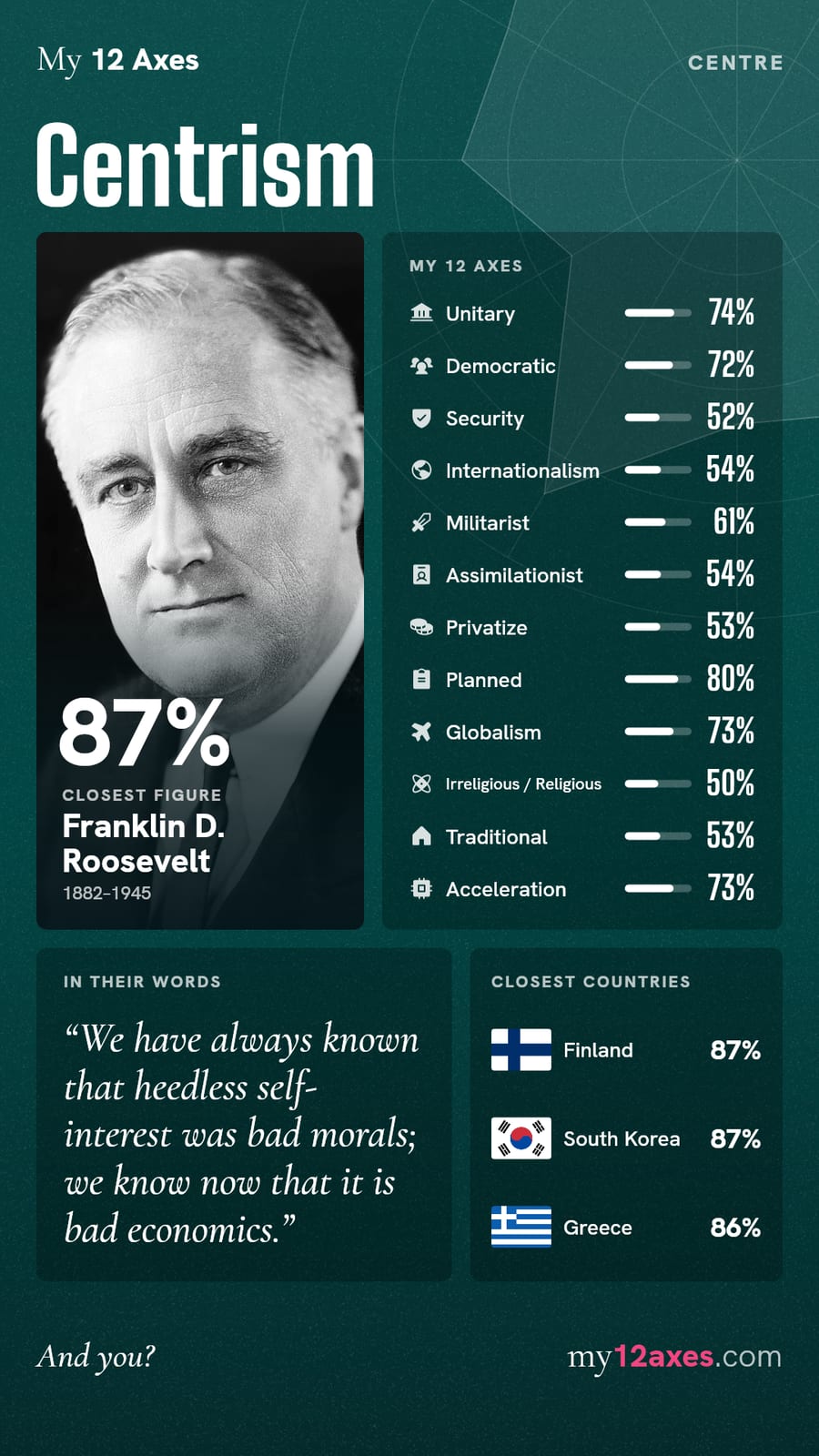
The 12 axes test asks 36, 60 or 288 plain statements and gives you twelve scores, your closest ideology, the historical figure nearest your ideas and the countries that think most like you.
Free · No sign-up · Private · Instant result



What each of the 12 axes means
The 12 axes sit in four groups. Each one runs between two poles, and your score is how far you lean toward one of them.
Government
FederalUnitary
DemocraticAutocratic
SecurityFreedom
State structure. Measures how political power is divided between central and regional government. Federalists favour regions with real autonomy; unitarists want one central authority.
Representation. Measures who holds political power and how it is chosen. Democrats want citizens to decide, directly or through elections; autocrats accept rule by one person or a small group.
Authority. Measures how much power the state should have over individuals. Those on the security side accept surveillance, order and control; those on the freedom side limit the state and protect individual choice.
Diplomacy
InternationalismNationalism
MilitaristPacifist
AssimilationistMulticulturalist
Sovereignty. Measures how much a country's decisions should be shared with other nations. Internationalists favour cooperation and common institutions; nationalists put national interests and sovereignty first.
Military posture. Measures the role of force in a country's foreign policy. Militarists see strong armed forces as a normal means of protecting or extending interests; pacifists reject war and armaments.
Integration. Measures how a society should treat cultural differences, especially among immigrants and minorities. Assimilationists expect newcomers to adopt the main culture; multiculturalists support several cultures side by side.
Economy
CollectivizePrivatize
PlannedMarkets
IsolationismGlobalism
Ownership. Measures who should own the means of production. Collectivists want shared or public ownership; privatisers want property and enterprise held by individuals and firms.
Economic control. Measures how much the government should direct the economy. The planned pole wants state planning and heavy regulation; the market pole wants prices and competition to decide.
Trade. Measures how open a country should be to foreign trade and economic ties. Isolationists favour tariffs and self-reliance; globalists favour open borders for goods and capital.
Society
IrreligiousReligious
ProgressiveTraditional
AccelerationBioconservative
Religion. Measures the importance of religion in public life and belief. The irreligious side sees religion as unnecessary or false; the religious side treats faith as central to society and morality.
Social change. Measures attitudes to changing social norms and customs. Progressives favour reform and new ways of living; traditionalists favour inherited customs and the established social order.
Technology. Measures attitudes to rapid technological change, including changes to the human body. Accelerationists push for faster progress and enhancement; bioconservatives want limits to protect nature and human identity.
Find your closest countries
Set the 12 axes to where you stand. The ten closest countries reorder as you drag, by the same distance the test uses.
- Mongolia90%
- Senegal90%
- Nepal90%
- Germany88%
- Mozambique88%
- Mexico87%
- Colombia87%
- Albania87%
- Austria87%
- Czechia87%
How the 12 axes test works
The 12 axes test is a set of plain statements and nothing else. The 12 axes result examples show what you get at the end.
- 1
Answer the statements
Agree or disagree on a seven-point scale with statements about government, the economy, foreign policy and society.
- 2
Get scored on 12 axes
Every statement moves one axis, and each axis is asked from both sides, which offsets the habit of agreeing with whatever you read.
- 3
See your profile
Your ideology, closest figure and countries appear at once. Everything is worked out in your browser.
Questions about the 12 axes test
Is the 12axes test free?
Yes. All three lengths and the full result are free, with no ads and no sign-up. An optional paid report may be added later; it will never be needed to see your result.
How long does the 12 axes test take?
About 3 minutes for 36 statements, 5 minutes for 60 and 20 minutes for all 288. Your place is kept in the browser if you stop halfway.
Is it the same as 12 axis or 12axestest?
People search for this test under several spellings, such as 12 axis test and 12axestest. This site is an independent version in English and Brazilian Portuguese, built on the open-source 12axes question bank.
What are the 12 axes?
Federal or unitary, democratic or autocratic, security or freedom, internationalism or nationalism, militarist or pacifist, assimilationist or multiculturalist, collectivize or privatize, planned or markets, isolationism or globalism, irreligious or religious, progressive or traditional, and acceleration or bioconservative.
Are my answers stored?
Only in your own browser. They stay there after you finish, until you use Forget my results or clear the site data. The site does not receive them unless you order the report. Your scores are written into the result link, so anyone you send that link to can see them.
Why did my result change when I retook it?
The two shorter rounds draw a different sample of statements each time, so scores move by several points. The 288-statement round asks the same statements every time and is the most stable.
Why twelve axes and not a left-right line
Left and right bundle dozens of separate questions into one word. Someone can want open borders and low taxes, or a strong welfare state and a strict moral code. A single line calls both of those people confused. The 12 axes keep those questions apart, so that combination shows up as a shape and not as a contradiction.
Each axis is scored on its own. Being strongly in favour of markets says nothing about what you think of religion in public life, or about whether power should sit with regions or the capital. That is the main difference between this and a two-axis compass: there is far less room for one topic to drag the rest of your result with it.
How much to trust the numbers
Treat your result as a conversation starter and not a diagnosis. A test can only measure what you say you agree with on the day you take it, and statements read differently depending on where you live. The closest figure is a comparison of published positions, not a claim that you and they would have got along.
Country and figure profiles are editorial estimates on a seven-step scale. They are good for seeing broad similarities, and a difference of a few points between two countries does not mean much. The method and the sources for the questions are on the about this 12 axes test.